
Ask three managed IT providers whether they have industry experience and all three will say yes. The word does very little work on its own.
What's worth asking instead is what actually changes when the same service is delivered into a plant versus a clinic versus a distribution center. The answer isn't the help desk — a locked-out user is a locked-out user everywhere. It's three other things: what the law requires you to be able to prove, which systems can't be touched during business hours, and how much of your network lives somewhere a person has to physically walk to.
Here's what separates the three environments CTC works in most, and what to require from a provider in each.
A plant runs two networks that were designed by different people for different purposes. The business network — email, ERP, file shares, the office printers — behaves like any other company's. The production network doesn't. Programmable logic controllers, human-machine interfaces, historians, machine-attached PCs, vision systems, and increasingly sensors that report back to a vendor's cloud all sit on the floor, and most of them were installed by the equipment manufacturer rather than by anyone in IT.
NIST's Guide to Operational Technology Security (SP 800-82 Revision 3, published September 2023) is explicit about why the usual IT playbook transfers badly: OT systems have different performance and reliability requirements, use operating systems and applications that standard IT practice can treat as unconventional, and carry safety and physical consequences that a compromised spreadsheet does not. NIST also publishes a manufacturing-specific profile of the Cybersecurity Framework (NISTIR 8183 Revision 1, October 2020) for exactly this reason.
The practical version: a provider who patches everything on a standard monthly cycle will eventually push an update to a machine-attached PC mid-run, and you will lose a shift finding out.
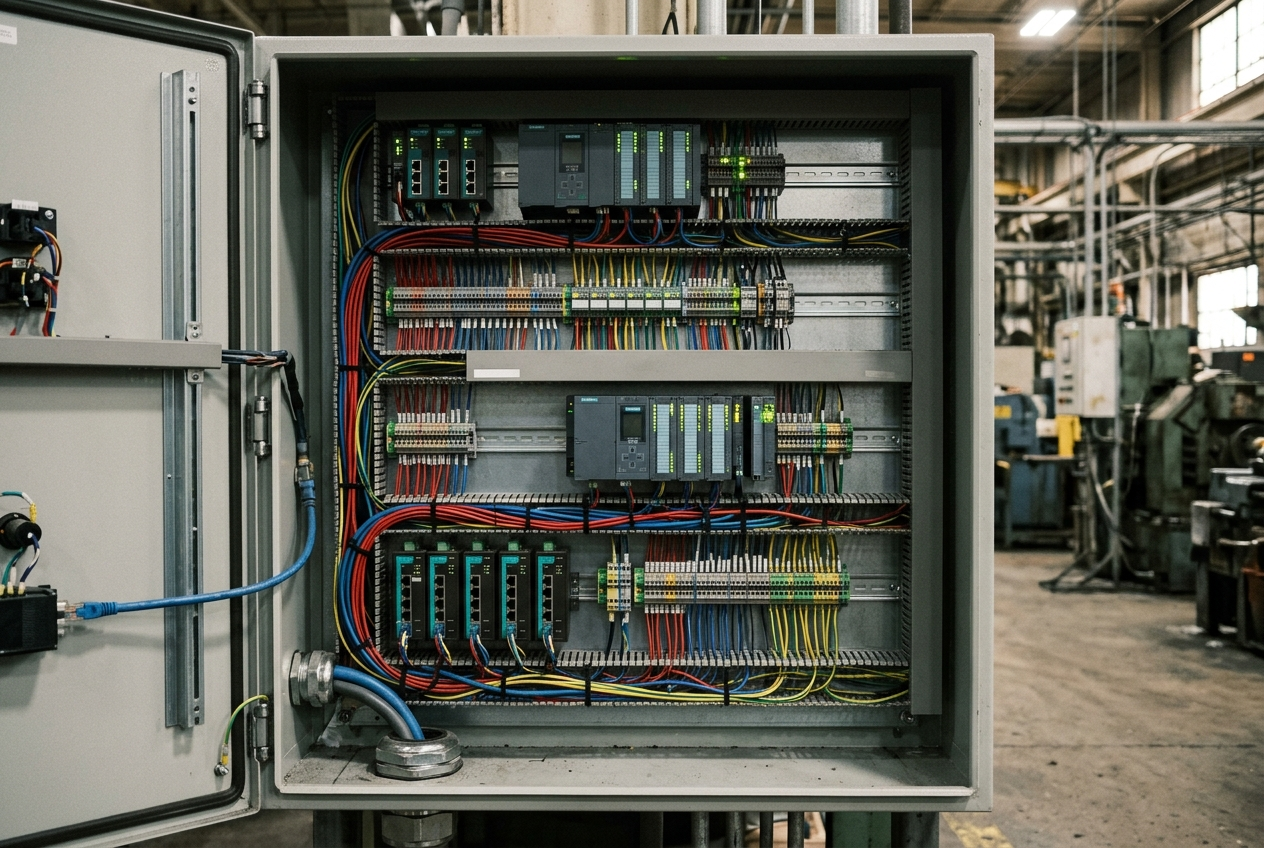
You cannot secure what you haven't counted. In August 2025, CISA and eight partner agencies published Foundations for OT Cybersecurity: Asset Inventory Guidance for Owners and Operators, which lays out fourteen high-priority data fields as the minimum an OT asset record should carry — not just what the device is, but where it sits, what it talks to, who supports it, and what happens if it stops.
Most plants do not have this. Getting it built is the first real deliverable of a competent engagement, and it's the thing you should own outright at the end of it.
If you want the fuller picture of how this works day to day, CTC's manufacturing IT services page covers the service side.
Everything above applies, plus two things that change how the work gets done.
The first is the physical environment itself. Washdown areas, temperature-controlled rooms, and sanitation cycles are hostile to ordinary network hardware, and equipment that's merely "industrial" often isn't rated for what happens in a wash cycle. Enclosure ratings and cable pathway design stop being an installation detail and start being the difference between quarterly replacements and equipment that lasts.
The second is traceability. Lot tracking, batch records, environmental monitoring, and the systems that hold them are recordkeeping obligations, not conveniences — which means backup, retention, and the ability to actually produce a record are operational requirements rather than IT preferences. A provider should be asking what your records retention obligations are during onboarding. If nobody asks, nobody has planned for it.
Healthcare is the one vertical where "what does good look like" has a legal answer. The HIPAA Security Rule sorts its implementation specifications into Required and Addressable, and the distinction is widely misunderstood — "addressable" does not mean optional. It means you either implement it, or implement an equivalent alternative, or document why it isn't reasonable and appropriate in your environment. The documentation is itself the obligation.
Some of what falls where, under 45 CFR § 164.312:
And under § 164.308, the administrative safeguards: risk analysis is Required, and within the contingency plan standard, the data backup plan, disaster recovery plan, and emergency mode operation plan are all Required, while testing and revision procedures and applications and data criticality analysis are Addressable.
Read that list again with an eye to what it means operationally. A backup that has never been restored satisfies nothing. The plan has to exist, and the evidence that it works is what you'd be asked for.
HHS Office for Civil Rights reported 663 breaches affecting 500 or more individuals in calendar year 2024, involving approximately 242.9 million individuals, with 81% attributed to hacking. A further 74,299 smaller breaches were reported in the same period. Those figures come from OCR's breach report to Congress covering 2024.
A note on what's coming: HHS published a Notice of Proposed Rulemaking on January 6, 2025 that would substantially strengthen the Security Rule — including removing the Required/Addressable distinction entirely and making nearly everything mandatory. It is still a proposal. Nothing in it is in force. Treat any provider who tells you otherwise as someone selling on a deadline that doesn't exist. Treat it as a planning signal instead: the direction of travel is toward fewer optional controls, and organizations already implementing addressable specifications will have less work ahead of them.
CTC's healthcare IT services page goes further on the service specifics.
In an office, a network problem is an inconvenience. In a distribution center, the network is the process: handheld scanners, forklift-mounted terminals, voice picking headsets, label printers, dock door sensors, and the warehouse management system tying them together. When coverage drops in an aisle, work stops in that aisle.

This makes distribution the most physical of the three environments, and the one where the gap between a provider who manages networks and a provider who also builds them shows up fastest.
Strip out the regulatory language and the physical differences and the same three requirements sit underneath every one of these environments:
Someone has counted what you have. Asset inventory is the foundation of the OT guidance, the first step of a HIPAA risk analysis, and the only way to know what's on your warehouse floor. It's the same deliverable wearing three hats.
Someone has decided what can't be touched during business hours, and written it down. Plant, clinic, or DC, the systems that can't take a standard patch cycle are the ones that hurt you, and the answer is always segmentation and compensating controls rather than universal patching.
Someone can physically get there. All three of these are buildings with equipment in them. A provider whose entire model is remote sessions will be excellent right up until the problem is a cable, and then you're waiting.
That last one is worth weighing carefully — we compare the tradeoffs in on-site versus remote support.
Does industry experience actually matter when choosing a managed IT provider?
In offices, less than providers claim. In plants, clinics, and distribution centers, considerably — because each has systems that can't be patched on a normal schedule, and knowing which ones and why is learned from the environment rather than from a certification.
What's different about IT support for manufacturing?
Operational technology. PLCs, HMIs, historians, and machine-attached PCs need segmentation from the business network and compensating controls rather than standard patching, because an update pushed mid-run costs production. NIST publishes specific guidance for this environment.
What does HIPAA actually require from an IT provider?
A signed business associate agreement, documented risk analysis, access control down to the individual user, audit logging, and backup and recovery plans — with a documented position on every addressable specification, whether implemented or not. The documentation is part of the requirement, not evidence of it.
Why do warehouses have so many wireless problems?
Metal racking, moving equipment, and seasonal layout changes all reshape RF coverage, and a survey done under one configuration doesn't describe another. Handheld scanners and vehicle-mounted terminals are also less tolerant of marginal coverage than a laptop is.
Can one provider handle all three environments?
Yes, if they do physical infrastructure work themselves and can speak to operational constraints rather than only to IT ones. The common requirement across all three is a provider who can be in the building.
CTC Technologies supports Michigan manufacturers, healthcare organizations, and distribution operations from an Ann Arbor headquarters. We manage networks and we also build them — the cabling, the wireless survey, and the network refresh come from the same team that answers the ticket.
A good place to start is an assessment scoped to your environment rather than a generic one — the OT side of a plant, the compliance evidence in a clinic, the RF coverage in a warehouse. Different buildings, different first questions.
Request an IT assessment or call 734-408-0200. Managed IT across Michigan, including Detroit, Warren, Livonia, Sterling Heights, Kalamazoo, and Ann Arbor.


